


Tool results disappear into files with no context.
Organize records of actions, identities, times and sources.
Reconstruct which command ran with which input. Separate source files from working extracts.
Illustration of a working environmentEnrolment opening soon
Recon and terminal-based evidence
Learn reconnaissance and log analysis that preserves where every result came from. Combine terminal commands, data filtering, HTTP observations and integrity checks into a clear package for a reviewer or client.
PLN 349planned price including tax
In your browser · No installation · Tutor and narration
Open your browser. Start learning.
Do not spend your first evening configuring an environment. The application, tools and task context are in one place. You do not need Docker, a VPN, a virtual machine or paid software.
A virtual tutor walks you through the example and highlights important parts of the application, code or tool. Connect the instruction to what is happening on screen.
Narration explains the mechanism, decision and result. Pause the guidance, return to an earlier step and work through it at your own pace.
Take over in the exercise: change data, run a test or make a decision. Compare the result and improve your solution using the explanation.
One environment, without switching between a video and a local installation. Tools fit the topic: from HTTP requests and code to a terminal, calculator or document. Practice in simulators and prepared cases, without attacking other people's systems.
What will you be able to do?
Do not stop at command output. Preserve its context and prepare material someone else can check.
Tool results disappear into files with no context.
Reconstruct which command ran with which input. Separate source files from working extracts.
You have a request and a log but do not know whether they describe the same event.
Identify the entry corresponding to the test and what it confirms. Mark missing data instead of inventing the sequence.
The report receives an entire folder or a terminal screenshot.
Prepare an evidence index, an organized package and instructions for checking the finding again.
Develop skills for reconnaissance, log analysis and handing evidence over for review. A discovered resource remains a lead until verified.
Connect each skill to a concrete work product. Return to explanations while you practice.
A syllabus backed by materials
See what makes up the syllabus: lessons, explanations, examples and exercises. The figures below describe different types of materials.
The figures describe the English-language source materials. The waiting list is for the planned Polish edition. These counts do not mean its translation is complete. Demonstration steps, examples and tasks are different units, not hours of video or counts of unique vulnerabilities.
Entry point
Available in Polish and English — you can switch language at any time. Command names, code snippets and standard identifiers remain in their original form.
How you learn
The tutor walks through an example and explains each decision. In the exercise, return to the context, check the result and improve your answer.
Goal, constraints and inputs. Know what you are testing and why.
Watch a demonstration with tutor commentary, step by step.
Work with data, a tool or a scenario. Compare the result with your expectation.
Justify your decision and understand its limitations. Return to anything that needs improvement.
Exercises use simulators and selected mechanisms that run in the browser. They do not require attacking other people's systems.
Planned syllabus
Each area develops a specific skill. Learn not only the topic but also the action and outcome that learning leads to.
Each topic includes a skill and a concrete exercise outcome.
I want to join the listEstablish the user, working directory, time and tool versions before analysis. Prepare a directory structure and activity log. Command records will then carry the context needed to explain the output.
Tutor-guided exercise
Choose whole-file, partial or numbered-line views to suit the material's size. Practice filename patterns, content search and argument quoting. Also check hidden files and case-sensitive differences.
Tutor-guided exercise
Combine grep, sort, uniq, cut and awk to analyze paths and events. Trace stdout, stderr, overwriting and appending output. Prepare a readable log extract while preserving the input material.
Tutor-guided exercise
Read users, groups and file modes, including special permission bits. Record the state before and after a change. Choose minimal access to the material instead of simplifying work with excessive permissions.
Tutor-guided exercise
Translate engagement scope into allowed sources and commands. Compare supplied public reconnaissance results with authorized service validation. Ask about newly discovered resources when authorization does not settle whether they may be tested.
Tutor-guided exercise
Preserve headers, response bodies and exact requests. Compare an interesting path's result with a nonexistent resource to identify a soft 404 false positive. Identify observations that justify further analysis.
Tutor-guided exercise
Connect entries from different logs through request identifier, user and time. Build an event timeline and verify context consistency. Distinguish what the application confirms from assumptions based only on nearby timestamps.
Tutor-guided exercise
Record metadata and file hashes and build a manifest. Verify consistency after copying or archiving. Connect byte changes to file provenance so the recipient knows what they received.
Tutor-guided exercise
Preserve the original and prepare a separate recipient copy. Remove unnecessary secrets and data while retaining what explains the finding. Label source and redacted files.
Tutor-guided exercise
Prepare request-reproduction commands and explicit success or failure conditions. Check rejection of unauthorized operations and preservation of legitimate functionality. Record results so success follows from verification, not merely script completion.
Workshop with prepared data
Assemble an archive with a timeline, report copy, contents index and retest commands. Check the delivered file's hash and describe each material's purpose. Give the recipient an organized assessment record, not an unlabeled folder.
Workshop with prepared data
In practice
Each case has context, a concrete action and an outcome. The goal is not to memorize a command but to understand why the result changed.
Find relevant lines, prepare filters and connect identifiers with time and user. Compare sources to establish what is actually known about data access.
Work productAn event timeline and log extract linked to the finding description.
Preserve raw material, prepare a redacted copy and manifest. Include retest commands with explicit assessment conditions, then verify the delivery archive's integrity.
Work productAn organized archive, contents index and retest scenario.
Certificate of completion
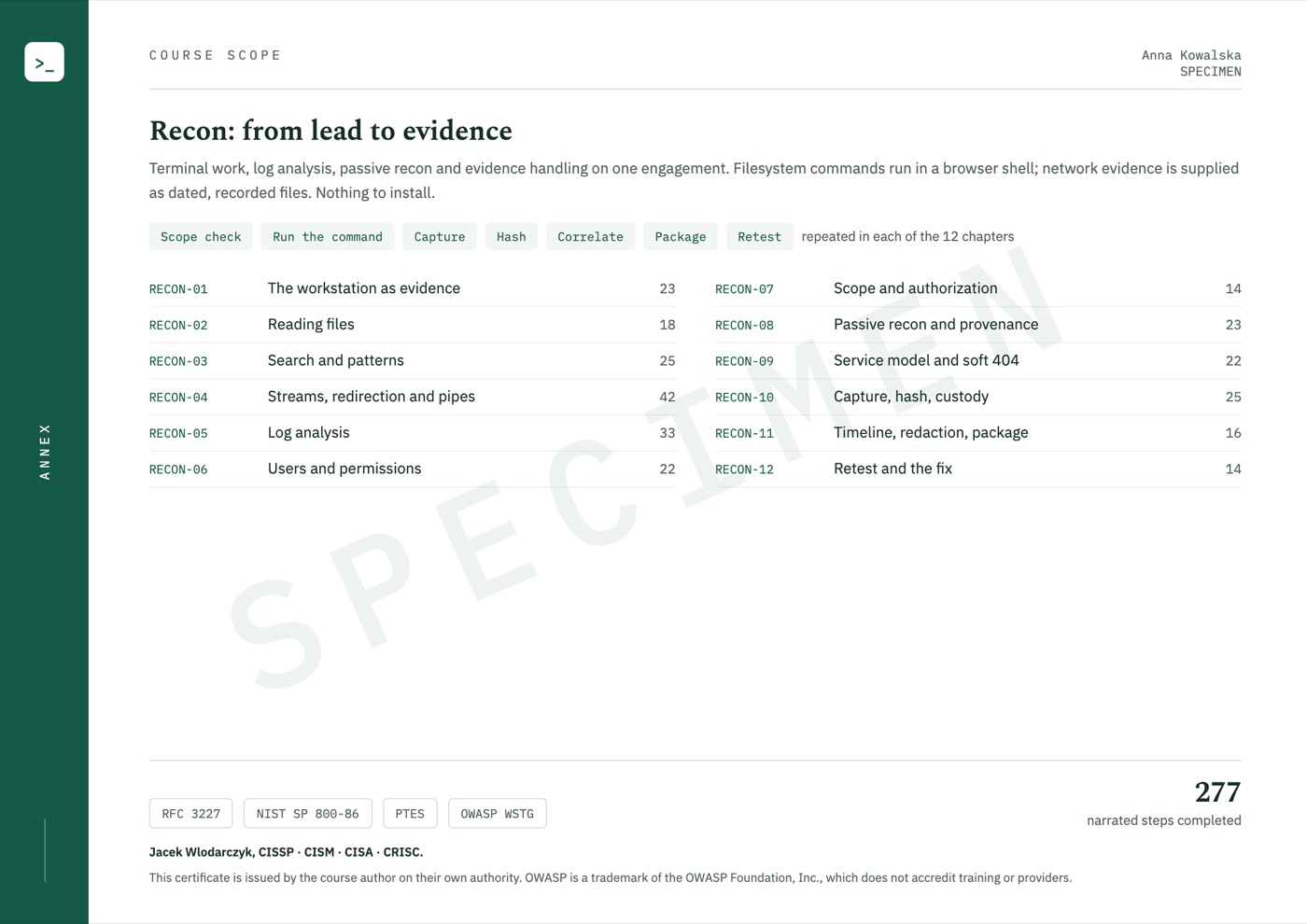
When you complete the course, the certificate is issued automatically and emailed to you. It shows your name, the date of issue and a unique code, and its second page lists the course scope.
Code verification: cyberszkola.pl/verify


Upcoming standalone course
Planned course price
Polish edition · Launch date not yet announced
Notify me at launchJoining is free. Before sales open, you will receive the date, full scope and purchase terms. We are not taking payments today. This is a separate interest list, not a place reservation or purchase.
For companies and teams
Compatible with LMS platforms including:
and other platforms that support e-learning standards.
Price for companies
Delivery into your company's own LMS from 50 licences.
Ask for a quoteWrite to kontakt@cyberszkola.pl: the number of people, the courses you want and your LMS, if you use one.
Before joining
Linux builds general terminal confidence. This course uses commands for a specific process: reconnaissance, log analysis, source preservation and evidence handover. Basic file navigation knowledge is useful beforehand.
Yes. Log filtering, file provenance and reproducible records also help incident analysis and troubleshooting. Course cases remain focused on security assessments.
No. This is an upcoming course announcement and an interest list. Joining is not a purchase, a place reservation or a commitment to pay.
The launch date, price and access terms will be announced before sales open. The interest list is how we send that information.
The course is available in Polish and in English — you can switch language at any time, and lessons, exercise explanations and narration exist in both. Commands, code and tool names keep their original syntax, as used in everyday work.
No. All course exercises run in your browser on a computer with internet access. Training applications, terminals, editors and workshops are part of the platform. You do not install Docker, a virtual machine or a VPN, and you do not need paid external tools.
No. You work in an interactive environment. A virtual tutor highlights important elements, and narration explains the action and its result. Pause the lesson, return to earlier steps and run your own experiments. This guidance is built into the course, not individual consultation with a person.
No. You use training applications, simulators and prepared data. Learn the mechanism and its limitations in a safe environment. External resources are supplementary, not required to complete the exercises.
Yes, a certificate of completion. When you complete the course, you receive a certificate in English with a unique code that anyone can check at cyberszkola.pl/verify. It confirms completion of the course and is issued by the author; it is not an industry certification. We do not promise employment.
No. These are independently authored courses using public references and original cases. They do not replace licensed standards, accreditation or qualifications required in regulated industries.
Join the waitlist
Leave your email address. We will send you news of enrollment, the syllabus and first-edition terms. You will not need to keep checking this page.
Planned price: PLN 349 including tax